For most of the last century, job security followed a predictable path.
Go to school.
Earn a degree.
Get a stable job.
Stay with the same company for decades.
That model worked during the industrial age and much of the information age. But today, the global economy is undergoing one of the most dramatic shifts in modern history.
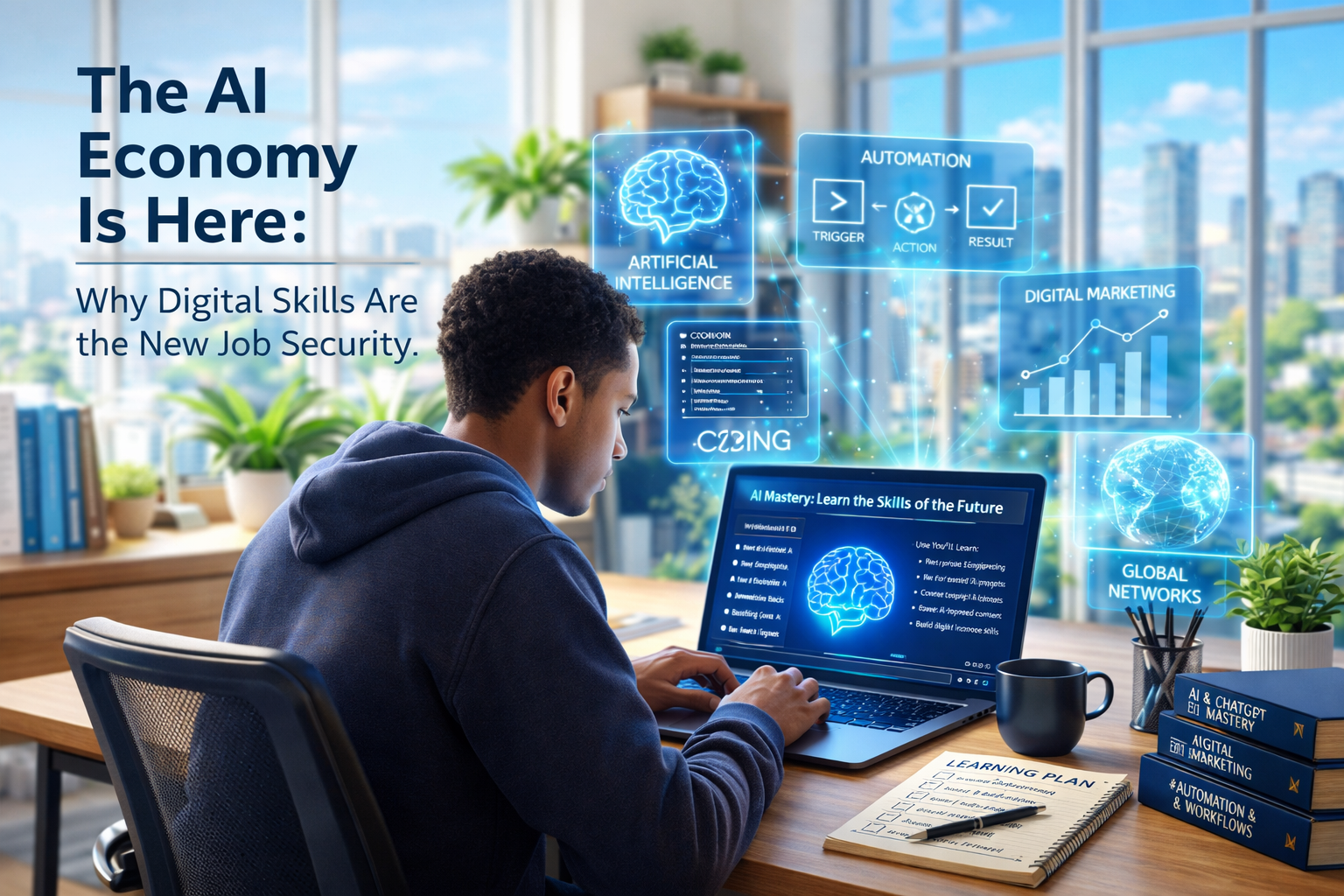
We have entered what many economists and technologists now call the AI Economy.
Artificial intelligence, automation, and digital systems are transforming nearly every industry—from finance and healthcare to marketing, logistics, education, and entertainment.
The question is no longer whether AI will impact work.
The question is who will be prepared for it.
In this new environment, the most valuable form of job security is no longer a job title or a company position.
It is digital skills.
The Global Shift Toward AI-Powered Work
Artificial intelligence is quickly becoming the operating system of modern business.
Companies are now using AI to:
- automate repetitive tasks
- analyze massive amounts of data
- generate marketing content
- write software code
- improve customer service
- optimize logistics and operations
This transformation is not limited to large technology companies.
Small businesses, startups, freelancers, and entrepreneurs are also adopting AI tools to operate more efficiently and compete on a global scale.
What once required entire teams of specialists can now be accomplished with:
- AI assistants
- automation software
- digital workflows
- cloud-based platforms
As a result, the workforce is changing rapidly.
The most valuable employees and entrepreneurs today are those who understand how to work alongside AI tools rather than compete against them.
Why Digital Skills Are the New Job Security
In the past, job security often came from experience or tenure.
Today, it comes from adaptability and digital capability.
Digital skills allow individuals to:
- work across multiple industries
- adapt to new technologies quickly
- build independent income streams
- remain competitive in evolving markets
For example, someone who understands how to use AI tools can:
- automate marketing campaigns
- build digital products
- analyze business data
- create content at scale
- design AI-powered business systems
These skills provide a level of flexibility and leverage that traditional career paths often cannot.
Rather than relying on a single employer for stability, individuals with strong digital capabilities can create opportunities in multiple ways.
The Rise of the AI-Augmented Professional
The future workforce will not be divided simply between humans and machines.
Instead, it will be defined by AI-augmented professionals.
These are individuals who understand how to use AI as a productivity multiplier.
For example:
A marketer using AI can generate campaigns in minutes.
A business consultant can analyze large datasets quickly.
An entrepreneur can build digital products faster than ever before.
AI does not replace the human professional—it amplifies their capabilities.
Those who learn how to use AI effectively will be able to produce more value, solve problems faster, and operate at a scale that was previously impossible.
The Role of Practical AI Education
As this shift accelerates, traditional education systems often struggle to keep up with the speed of technological change.
Many universities and institutions still focus on theoretical knowledge rather than practical digital skills.
This gap has led to the rise of modern learning platforms focused on real-world digital capabilities.
Platforms like NextGen Digi Academy are designed to help individuals learn the tools and strategies required to thrive in the AI-driven economy.
Rather than requiring years of study, these programs focus on practical knowledge that can be applied immediately.
Learning the Tools of the AI Economy
At NextGen Digi Academy, the focus is on helping individuals understand the tools shaping the future of work.
Courses and resources on the platform explore topics such as:
AI Prompt Engineering
Learning how to communicate effectively with artificial intelligence systems has become one of the most valuable digital skills.
Understanding prompts allows users to unlock the full potential of AI tools for research, marketing, automation, and business strategy.
AI-Powered Digital Entrepreneurship
The internet has created unprecedented opportunities for individuals to build businesses using digital products and automation.
AI tools make it possible for entrepreneurs to:
- generate product ideas
- build marketing campaigns
- automate customer interactions
- scale operations globally
Custom GPT Tools and AI Assistants
Custom GPT systems are becoming a powerful way to automate knowledge and workflows.
These AI assistants can help individuals:
- organize information
- generate ideas
- analyze data
- streamline business operations
Learning how to design and use these tools can significantly increase productivity.
Building Digital Income Streams
The AI economy is also enabling people to create new forms of income through:
- digital products
- AI-powered services
- online education
- consulting and automation systems
Understanding how to combine AI with digital platforms opens the door to entirely new opportunities.
The Opportunity of the AI Economy
Every major technological shift creates both disruption and opportunity.
The industrial revolution transformed agriculture and manufacturing.
The internet revolution transformed communication and commerce.
Now the AI revolution is transforming how work is done.
Those who ignore these changes may find themselves struggling to adapt.
But those who invest in digital skills today can position themselves at the forefront of a new economic era.
The tools are becoming more accessible.
The learning resources are expanding.
And the opportunity for individuals to create value has never been greater.
Preparing for the Future of Work
The future of work will not belong solely to those with the most degrees or the longest resumes.
It will belong to those who can:
- learn new technologies quickly
- adapt to changing industries
- leverage AI tools effectively
- build digital systems that create value
In other words, the future will belong to continuous learners and digital innovators.
The AI economy is already here.
The real question is whether we choose to participate in it—or simply watch it unfold.
For those willing to learn and adapt, the opportunities are just beginning.








0 Comments