Why Skill-Based Learning Is Becoming the New Path to Opportunity
For decades, the path to success followed a predictable script. Graduate from high school, enroll in a four-year college, earn a degree, and step into a stable career. That formula was repeated across generations and reinforced by society, institutions, and employers alike. A college degree was more than education. It was a signal. It told the world that you were prepared, disciplined, and capable of contributing value in a professional environment.
But something is changing, and it is happening faster than most people realize.
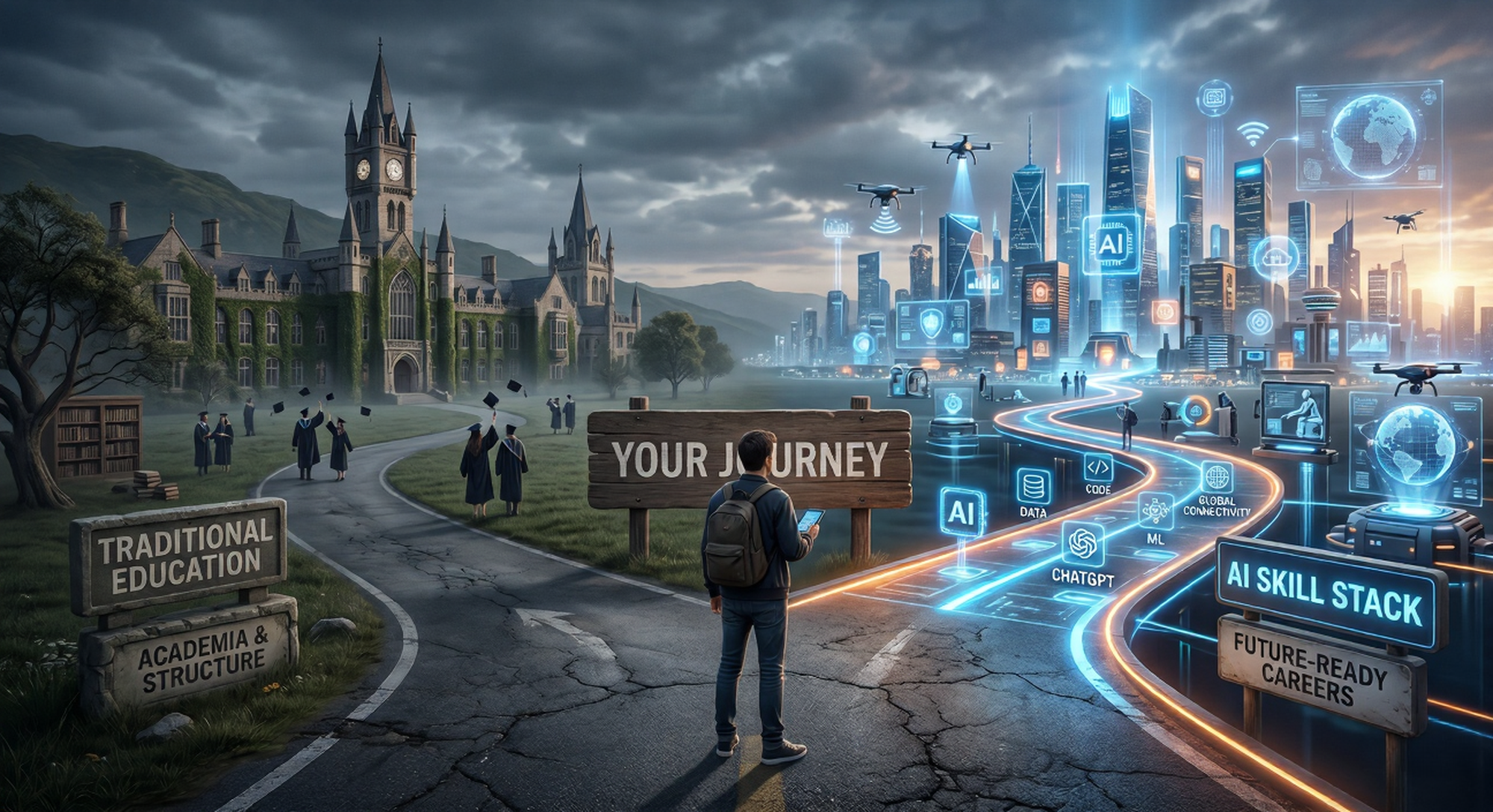
Artificial intelligence is not just transforming jobs. It is transforming how people learn, how they develop skills, and how they prove their value. The traditional four-year degree, once considered the primary gateway to opportunity, is now being challenged by a faster, more flexible alternative built around real-world capability.
We are entering a new era where what you can do matters more than what you can show.
The Shift From Traditional Credentials to Real-World Skills
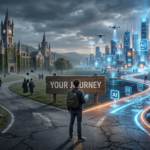
Imagine two individuals starting at the same point. One enrolls in a traditional college program, committing four years to structured learning, lectures, and exams. The other takes a different path. They begin learning digital skills immediately using AI tools. They experiment, build small projects, create content, test ideas, and refine their abilities in real time. Within months, they are producing work that can be seen, evaluated, and improved.
By the time the first individual graduates, the second may already have a portfolio, income streams, and practical experience that directly applies to the modern economy.
This is the shift toward skill-based learning.
Artificial intelligence accelerates this process in a way that traditional education simply cannot match. Instead of spending hours searching for information, learners can now access explanations, examples, and solutions almost instantly. Instead of passively listening to lectures, they can interact with knowledge, test ideas, and receive immediate feedback. The entire learning experience becomes faster, more dynamic, and more focused on results.
This does not mean that education itself is becoming less important. In many ways, it is becoming more important than ever. The difference is that education is no longer confined to classrooms or defined by degrees. It is continuous, adaptive, and increasingly powered by technology.
Why the Degree Signal Is Losing Its Power
In the past, a degree functioned as proof of capability. It acted as a shortcut for employers, signaling that a person had completed a certain level of training. But in today’s environment, that signal is becoming less reliable. Industries are evolving so quickly that what was taught just a few years ago may already be outdated. Employers are beginning to recognize this gap and are shifting their focus toward demonstrated ability rather than formal credentials.
That change matters.
In an AI-driven economy, employers, clients, and markets are paying closer attention to what a person can actually build, solve, automate, improve, and deliver. The old signal still carries weight in some areas, but for a growing number of careers, especially in digital business, technology, marketing, and entrepreneurship, practical capability is becoming the stronger currency.
The Rise of the Skill Stack
This idea is explored in depth in The Signal and the Skill Stack, where the distinction between signal and skill becomes central to understanding the future of work. The signal represents traditional credentials such as degrees, certifications, and titles. The skill stack represents the actual capabilities a person develops over time, including their ability to solve problems, use tools, and create value.
In an AI-driven economy, the importance of the signal is beginning to fade, while the importance of the skill stack is rising rapidly.
Consider how quickly new opportunities are emerging. Roles like AI content strategist, automation consultant, prompt engineer, and digital product creator barely existed a few years ago. Today, they are in demand. These roles are not defined by degrees. They are defined by skills. The people filling these positions are not waiting for institutions to catch up. They are learning in real time, using the tools available to them.
How AI Is Accelerating Skill Development
Artificial intelligence plays a central role in this transformation because it lowers the barrier to entry. Skills that once required years of specialized training can now be learned and applied much more quickly. A person can learn how to build a marketing campaign, analyze data, create content, or design a digital product with the assistance of AI tools. The learning curve is compressed, and the path to execution is shortened.
This creates a powerful advantage for those who are willing to adapt.
Instead of spending years preparing for a career, individuals can begin building one immediately. They can test ideas, create projects, and generate income while they learn. This approach not only accelerates skill development but also aligns more closely with how the modern economy operates.
The New Responsibility of Modern Learning
At the same time, this shift introduces a new level of responsibility. Without a predefined path, individuals must take ownership of their learning. They must decide what skills to develop, which tools to use, and how to apply them effectively. This requires discipline, curiosity, and a willingness to experiment.
For many, this may feel uncertain at first. The traditional system provided structure and clarity. But it also imposed limitations. The new model offers flexibility and speed, but it requires initiative.
The individuals who succeed in this environment will be those who embrace continuous learning. They will not view education as something that ends after graduation, but as an ongoing process of growth and adaptation. They will build skill stacks that evolve with the market, allowing them to remain relevant even as industries change.
What This Means for the Future of Work
This does not mean that the four-year degree will disappear entirely. There will always be fields where formal education is necessary. However, for a growing number of careers, especially those connected to digital business, technology, and entrepreneurship, the degree is no longer the primary differentiator.
What matters is what you can do.
Can you solve problems using modern tools? Can you create value in a digital environment? Can you adapt as technology evolves? These are the questions that define opportunity in the AI economy.
The shift from signal to skill is not just a trend. It is a fundamental change in how value is created and recognized. For those willing to embrace it, the possibilities are significant.
The future of work will not belong to those who simply follow traditional paths. It will belong to those who learn quickly, build continuously, and apply their knowledge in real time. It will belong to those who understand that education is no longer a one-time event, but a lifelong process powered by tools that make learning faster and more accessible than ever before.
Artificial intelligence is not replacing education.
It is redefining it.
And in this new reality, the most valuable investment anyone can make is not just in a degree, but in building a skill stack that can grow, adapt, and create opportunity for years to come.
Continue the Conversation
If this message resonates with you, go deeper with my book, The Signal and the Skill Stack, where I explore how traditional credentials are losing ground to practical, stackable, real-world skills in the AI economy.
Listen on Eleven Reader – Click Here To Listen
Listen on Barnes & Noble – Click Here To Listen
Take the Next Step With NextGen Digi Academy
If you are ready to build real-world digital skills for the future of work, NextGen Digi Academy is designed to help you move beyond theory and into practical application. Through AI-focused training, digital entrepreneurship education, and GPT-powered tools, you can begin building the kind of skill stack that creates lasting value in a changing world.
The future will favor those who learn, adapt, and execute. Now is the time to start.








0 Comments