
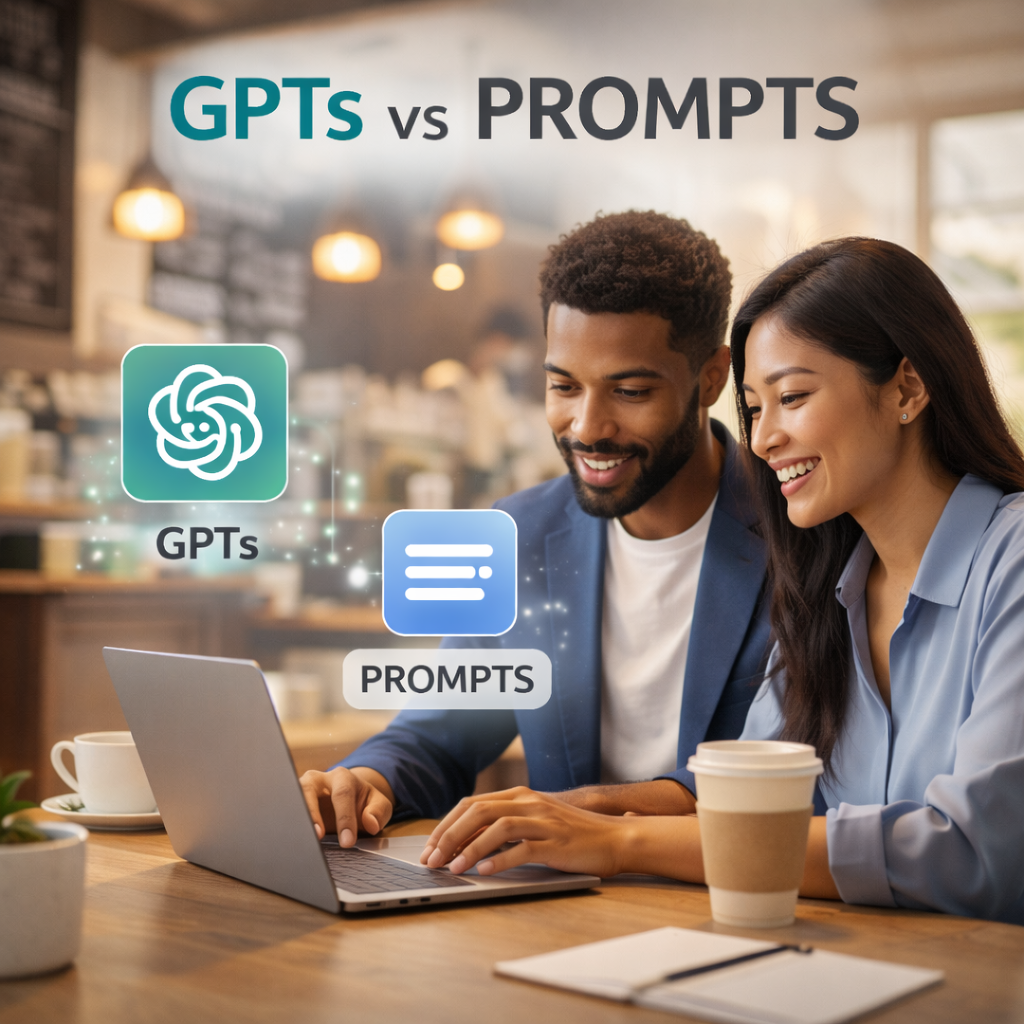
Artificial Intelligence is no longer a futuristic concept. Today, entrepreneurs, marketers, and business owners are using AI tools like ChatGPT every day to write content, answer customer questions, generate marketing ideas, and automate routine tasks.
But if you’ve spent any time exploring AI tools, you’ve probably seen two terms used frequently:
GPTs and prompts.
Many beginners assume they mean the same thing. In reality, they play very different roles in how AI works.
Understanding the difference between GPTs and prompts can dramatically improve the way you use AI in your business—helping you create better content, automate workflows, and get far more accurate results from tools like ChatGPT.
In this guide, we’ll explain:
-
What GPTs are
-
What prompts are
-
How GPTs and prompts work together
-
Why businesses are using both to increase productivity
What Is a GPT?
A GPT (Generative Pre-trained Transformer) is the artificial intelligence model itself.
It’s the engine that powers tools like ChatGPT.
GPT models are trained on enormous amounts of text and data so they can understand language, answer questions, and generate human-like responses.
Inside ChatGPT, businesses can create Custom GPTs, which are specialized AI assistants designed for specific tasks.
For example:
-
An SEO Writing GPT that produces blog articles optimized for Google
-
A Marketing GPT that generates social media campaigns
-
A Customer Support GPT that answers common questions
-
A Sales GPT that writes persuasive emails and proposals
Think of a GPT like a team member with specialized training.
The more focused the training and instructions, the better the results.
What Is a Prompt?
A prompt is the instruction you give to the GPT.
It’s the input that tells the AI what task to perform.
Without prompts, a GPT simply sits idle.
Prompts can be simple or highly detailed.
For example:
Simple Prompt
“Write a thank-you email for new customers.”
Detailed Prompt
“Write a friendly 300-word welcome email for new customers of an online store. Thank them for their purchase, highlight customer support options, and end with a discount offer for their next order.”
The more clear and detailed your prompt is, the better the output will be.
A useful way to think about it is this:
The GPT is the car.
The prompt is the driver telling it where to go.
How GPTs and Prompts Work Together
GPTs and prompts are not competing tools—they work together.
Even the most powerful GPT cannot deliver great results if the prompt is vague or poorly written.
At the same time, a well-written prompt can dramatically improve the output of even a standard AI model.
Businesses typically improve their AI performance in two ways:
1. Creating Custom GPTs
These are AI assistants trained for specific tasks or industries.
2. Developing Prompt Libraries
These are collections of proven prompts that teams reuse for common tasks.
Many successful companies combine both strategies to get the best results.
Why Businesses Are Using GPTs
Custom GPTs offer several major advantages for businesses that want to use AI effectively.
1. Massive Time Savings
AI can produce drafts, outlines, and ideas in seconds instead of hours.
2. Consistency Across Content
GPTs can follow brand guidelines, tone, and formatting instructions every time.
3. Scalability
Businesses can build multiple GPTs for different departments:
- Marketing GPT
- Sales GPT
- Customer Support GPT
- Operations GPT
This allows even small companies to operate with the efficiency of much larger teams.
Why Strong Prompts Are So Powerful
Even if you don’t create custom GPTs yet, improving your prompts can dramatically increase the quality of AI responses.
Strong prompts help businesses:
- Generate higher quality content
- Reduce editing time
- Speed up workflows
- Maintain consistent communication
For example, instead of typing:
“Write something about marketing.”
You could write:
“Write a 700-word blog article explaining how small businesses can use social media marketing to increase brand awareness. Use simple language and include practical tips.”
The second prompt will produce far better results.
Common Challenges When Using GPTs and Prompts
Despite the power of AI, businesses sometimes run into common problems.
Over-Reliance on AI
AI is a powerful assistant, but it should not replace human judgment or creativity.
Vague Prompts
Unclear instructions often lead to generic or confusing answers.
Poor GPT Setup
If a custom GPT isn’t configured properly, it may not perform as expected.
The solution is simple: clear instructions, careful review, and ongoing improvement.
Safety and Best Practices
When using AI tools in business, it’s important to follow basic safety guidelines.
Avoid entering sensitive information such as:
- Passwords
- Financial data
- Customer records
- Confidential company information
While AI systems are designed with security in mind, it’s always best practice to protect sensitive data.
Businesses should also review AI-generated content before publishing to ensure accuracy.
What Results Businesses Can Expect
When GPTs and prompts are used correctly, the benefits are significant.
Businesses often report:
- Faster content creation
- Improved marketing campaigns
- Better customer communication
- More time for strategic work
AI allows teams to focus on growth, creativity, and customer relationships while automation handles routine tasks.
Final Thoughts
The difference between GPTs and prompts is simple but incredibly important.
- GPTs are the AI engines or specialized assistants inside ChatGPT.
- Prompts are the instructions that guide the AI.
Both work together to produce useful results.
If you are just getting started with AI, focus first on learning how to write better prompts.
As your business grows, consider building custom GPTs tailored to your industry.
Together, these tools can help you save time, improve productivity, and scale your business faster.
Artificial intelligence isn’t here to replace business owners—it’s here to help them work smarter.
And mastering GPTs and prompts is one of the most powerful ways to unlock that potential.











0 Comments