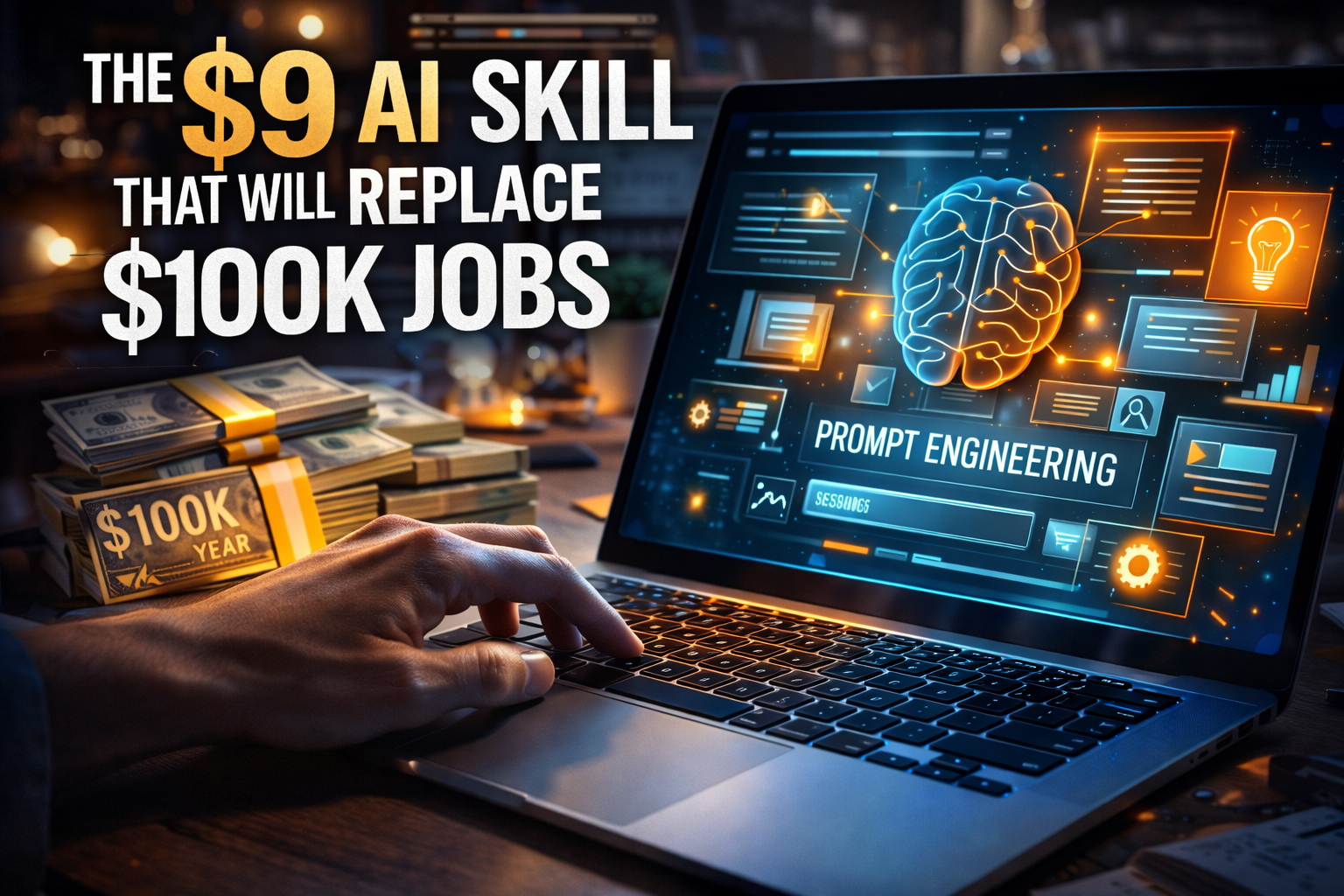
The $9 AI Skill That Will Replace $100K Jobs
And Why Learning It Might Be the Most Important Career Decision of the Next Decade
A quiet shift is happening in the workforce.
It’s not loud like the arrival of the internet in the 1990s.
It’s not dramatic like the smartphone revolution.
But it may ultimately prove to be just as transformative.
Across industries, a single skill is beginning to reshape how work gets done.
Surprisingly, this skill does not require a computer science degree.
It does not require years of technical training.
In many cases, people are learning it with tools that cost less than $10.
The skill is simple to describe, yet powerful in impact:
The ability to communicate effectively with artificial intelligence.
Some call it prompt engineering. Others call it AI collaboration.
But at its core, it is something very human.
It is the ability to think clearly, ask the right questions, and guide intelligent tools toward useful outcomes.
And for many professionals, this skill is quickly becoming the difference between staying relevant and falling behind.
The Real Shift Isn’t AI — It’s Leverage
For decades, high-paying jobs were built around specialized knowledge.
Marketing professionals wrote campaigns.
Analysts interpreted data.
Consultants developed strategies.
Designers created concepts.
These roles often paid $80,000 to $150,000 or more per year because they required expertise, time, and creative thinking.
AI is not eliminating the need for these skills.
What it is doing is compressing the time required to perform them.
Tasks that once took days can now take minutes.
Research can be summarized instantly.
Marketing ideas can be brainstormed in seconds.
Drafts can be generated almost immediately.
This creates a powerful form of leverage.
One person equipped with AI tools can now accomplish work that previously required an entire team.
The $9 Skill Most People Are Ignoring
Many people assume that the future belongs only to programmers or AI engineers.
But something surprising is happening.
The most valuable skill emerging in the AI era is not coding.
It is thinking clearly enough to guide intelligent systems.
That means learning how to:
• ask precise questions
• structure ideas clearly
• give context and constraints
• refine outputs through iteration
In other words, learning how to collaborate with AI rather than simply use it.
The cost of learning this skill can be incredibly low.
Many people are developing it through inexpensive tools, simple training resources, or affordable prompt frameworks.
In some cases, the entry point to understanding AI collaboration costs less than a cup of coffee.
Yet the productivity advantage it creates can be enormous.
Why This Skill Changes the Job Market
The workforce is entering a period where the value of work is shifting from manual effort to intellectual direction.
Consider two professionals performing the same role.
The first spends hours writing drafts, researching topics, and organizing information manually.
The second knows how to guide AI tools to generate drafts, summarize research, and create structured ideas in minutes.
Both may have the same job title.
But their productivity is dramatically different.
Over time, organizations naturally gravitate toward the individual who can produce more results with less friction.
This is how job roles evolve.
It’s not that jobs disappear overnight.
It’s that expectations quietly change.
Employers begin to expect the speed and efficiency that AI-enabled workers can deliver.
The Emotional Reality Behind the Technology
Whenever discussions about AI appear, they often create anxiety.
Many people worry that automation will eliminate careers they have spent years building.
Those concerns are understandable.
Change is rarely comfortable.
But throughout history, technological shifts have also created new opportunities for people willing to adapt.
The printing press changed how information spread.
Computers transformed office work.
The internet reshaped global communication.
Each transformation displaced some roles while creating entirely new ones.
Artificial intelligence is likely to follow the same pattern.
The people who benefit the most will not necessarily be the most technical.
They will be the ones who learn how to work alongside the technology.
The Hidden Advantage of Human Thinking
Despite all its capabilities, AI still relies on human direction.
It does not possess personal goals.
>It does not choose priorities.
>It does not understand the deeper context of a person’s life or business.
Humans still provide the most important ingredients:
• judgment
• creativity
• ethics
• strategic thinking
When someone combines these human strengths with AI tools, the result can be remarkably powerful.
The technology amplifies human thought rather than replacing it.
Learning the Skill Before It Becomes Obvious
Right now, we are in the early stage of a shift that will likely become mainstream in the next few years.
Today, many people are still experimenting with AI casually.
But forward-thinking professionals are beginning to build structured systems around it.
They are learning how to:
• create better prompts
• develop AI workflows
• automate repetitive tasks
• accelerate research and idea generation
These early adopters gain something incredibly valuable:
time.
Time to think.
>Time to build.
>Time to explore new opportunities.
In many cases, the biggest advantage AI provides is not just speed — it is mental freedom.
A Different Way to Think About Learning
One of the most encouraging aspects of this shift is that the barrier to entry is relatively low.
You do not need a specialized background to begin learning how to work with AI tools.
What you need most is curiosity and a willingness to experiment.
Learning how to guide AI effectively is less about memorizing commands and more about developing clear thinking.
When someone learns how to structure their ideas, ask better questions, and iterate on results, the technology becomes far more useful.
This is why modern learning platforms are increasingly focusing on practical skill development rather than long theoretical courses.
The goal is not just to understand AI.
The goal is to apply it in real situations.
Preparing for the Next Phase of Work
The future of work will likely reward people who can combine human insight with intelligent tools.
This does not require becoming a machine learning engineer.
It requires becoming a thoughtful collaborator with technology.
Professionals who develop this ability will be able to:
• work faster
• test ideas more quickly
• build systems more efficiently
• focus on higher-level thinking
In many ways, the most valuable skill in the coming decade may not be technical mastery.
It may simply be the ability to think clearly enough to guide powerful tools.
A Practical Starting Point
For individuals who want to explore these ideas further, the best approach is often to start small.
Experiment with AI tools.
Practice refining prompts.
Observe how the quality of results improves when instructions become more specific and structured.
Over time, this process becomes second nature.
The technology becomes less intimidating and more like a creative partner.
Platforms such as NextGen Digi Academy are beginning to explore this type of practical, skill-based learning — focusing on helping individuals understand how to apply modern tools in real-world situations rather than overwhelming them with theory.
The goal is simple:
Help people develop skills that move them forward.
The Opportunity in Front of Us
Every generation faces a moment when new tools reshape how work happens.
Those moments can feel uncertain.
But they also create opportunity.
The individuals who stay curious, adaptable, and open to learning often discover that new technology does not eliminate their value.
It expands it.
The question is not whether AI will change the job market.
It already is.
The more important question is whether we will learn how to use these tools thoughtfully and responsibly.
Because the most powerful advantage in the AI era may not be the technology itself.
It may simply be the human ability to guide it wisely.












0 Comments