For generations, education followed a familiar timeline.
Students spent years in classrooms learning theory before entering the workforce. A degree often represented the gateway to career opportunity and financial stability.
But the world has changed dramatically.
Technology now evolves faster than traditional education systems can adapt. Skills that were cutting-edge just a few years ago may already be outdated.
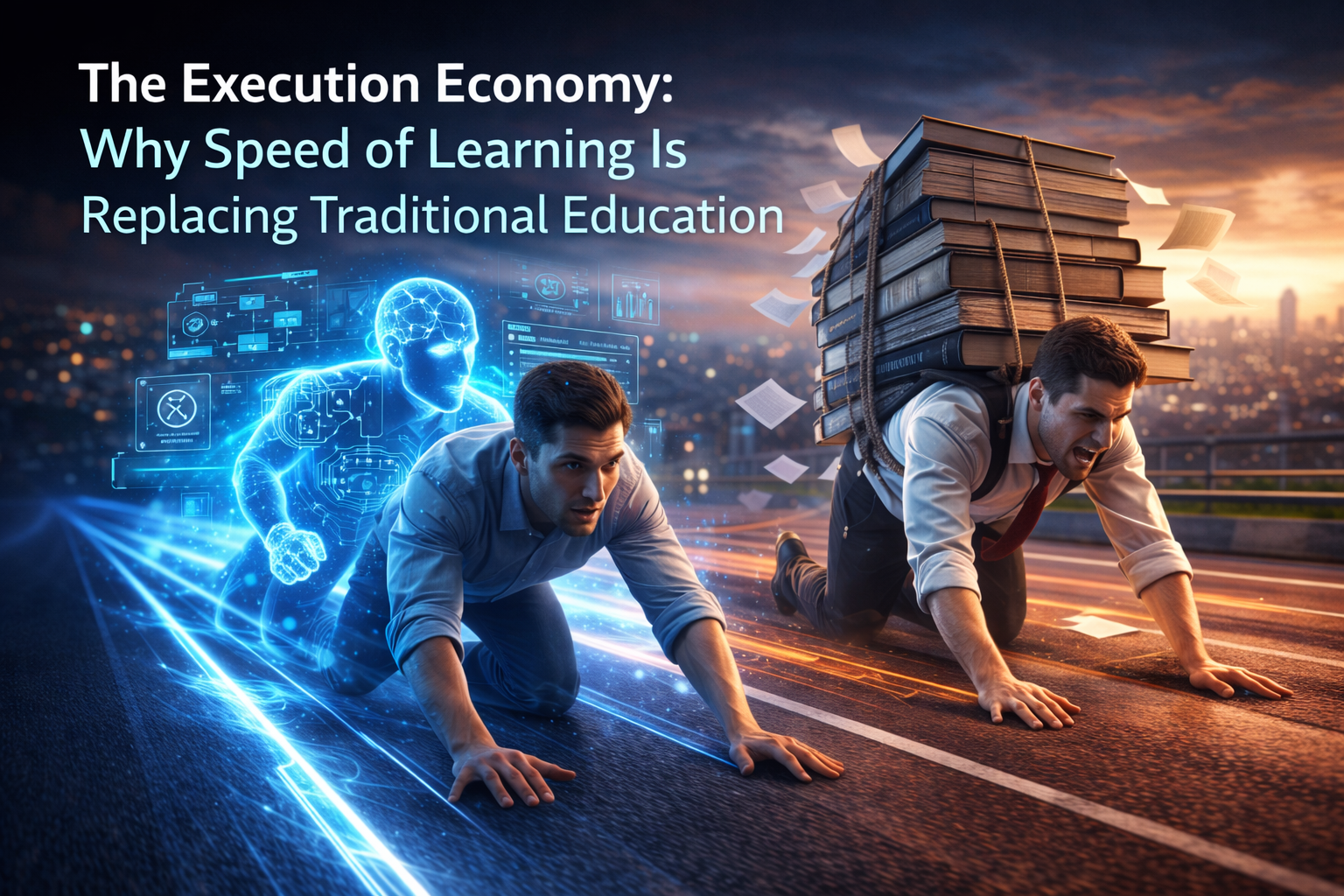
We are entering what many experts are beginning to call the Execution Economy.
In this new environment, success is no longer determined by how long someone studies a subject.
Instead, it is determined by how quickly someone can learn, apply, and execute new skills.
The Acceleration of Technology
Artificial intelligence, automation, and digital platforms are transforming industries at an unprecedented pace.
Companies are constantly adopting new tools to improve efficiency, reduce costs, and stay competitive.
For example, businesses are now using AI to:
- generate marketing content
- automate customer support
- analyze business data
- design products
- write software code
- optimize operations
Because these tools are evolving rapidly, workers and entrepreneurs must continually update their skill sets.
This is why the traditional model of education—where learning happens only at the beginning of a career—is becoming less effective.
In the AI economy, learning must be continuous and practical.
The Rise of the Execution Economy
The Execution Economy rewards people who can quickly turn knowledge into results.
Instead of spending years studying theory, individuals can now learn practical skills in weeks or months using online platforms, AI tools, and real-world projects.
This shift is creating a new type of professional:
The rapid learner.
These individuals focus on:
- learning new technologies quickly
- experimenting with tools
- applying knowledge immediately
- building digital systems that create value
The difference between success and stagnation is often not intelligence or education level—it is speed of execution.
Why Fast Learning Matters More Than Ever
In the modern digital economy, opportunities often appear and disappear quickly.
New industries emerge almost overnight.
Consider just a few examples:
- AI prompt engineering
- automation consulting
- digital product creation
- AI-powered marketing
- custom GPT development
Many of these roles barely existed a few years ago.
The people who benefit most are those who learn quickly enough to participate in these emerging opportunities.
The ability to adapt and execute becomes far more valuable than simply possessing credentials.
The Role of AI in Accelerating Learning
Ironically, the same technology disrupting industries is also making learning faster and more accessible.
Artificial intelligence tools can now help individuals:
- research topics instantly
- generate ideas and strategies
- automate repetitive work
- build prototypes quickly
- analyze large amounts of information
Instead of spending months searching for answers, learners can now explore complex topics with AI assistance in a fraction of the time.
This allows people to move from learning to execution much faster.
Practical Skill Development in the AI Economy
As the Execution Economy grows, practical skill-based education is becoming increasingly important.
Many individuals are now turning to online learning platforms that focus on real-world digital skills rather than theoretical knowledge.
Platforms like NextGen Digi Academy are designed to help individuals understand and apply the tools shaping the future of work.
Courses and resources focus on areas such as:
AI Prompt Engineering
Learning how to communicate effectively with artificial intelligence systems is quickly becoming one of the most valuable skills in the digital economy.
Prompt engineering allows users to guide AI tools to produce useful outputs for business, marketing, research, and automation.
AI-Powered Business Systems
Entrepreneurs can now build businesses using AI tools that automate many operational tasks.
These systems can help generate content, analyze markets, manage customer interactions, and streamline workflows.
Understanding how to build and manage these systems can dramatically increase productivity.
Custom GPT Tools
Custom GPT assistants are becoming powerful productivity tools for individuals and organizations.
These tools can be designed to:
- organize knowledge
- automate research
- support business decisions
- streamline digital workflows
Learning how to create and utilize these AI assistants provides a significant advantage in the modern economy.
Why Execution Is the New Competitive Advantage
The individuals who thrive in the AI economy will not necessarily be those with the most traditional credentials.
Instead, success will favor people who:
- learn quickly
- experiment with new tools
- adapt to technological changes
- apply knowledge to real-world problems
In other words, the key advantage will be execution speed.
The faster someone can move from learning to application, the more opportunities they can capture.
The Future Belongs to Fast Learners
The modern workforce is undergoing a transformation.
Careers will no longer follow rigid paths defined by degrees or job titles.
Instead, they will evolve continuously as individuals develop new capabilities and adapt to changing technologies.
The most successful professionals of the future will likely be those who:
- embrace continuous learning
- leverage artificial intelligence
- build digital systems that create value
- execute ideas quickly
The Execution Economy rewards curiosity, experimentation, and action.
And for those willing to learn and adapt, the possibilities are greater than ever before.










0 Comments