Every morning, millions of people begin the same journey.
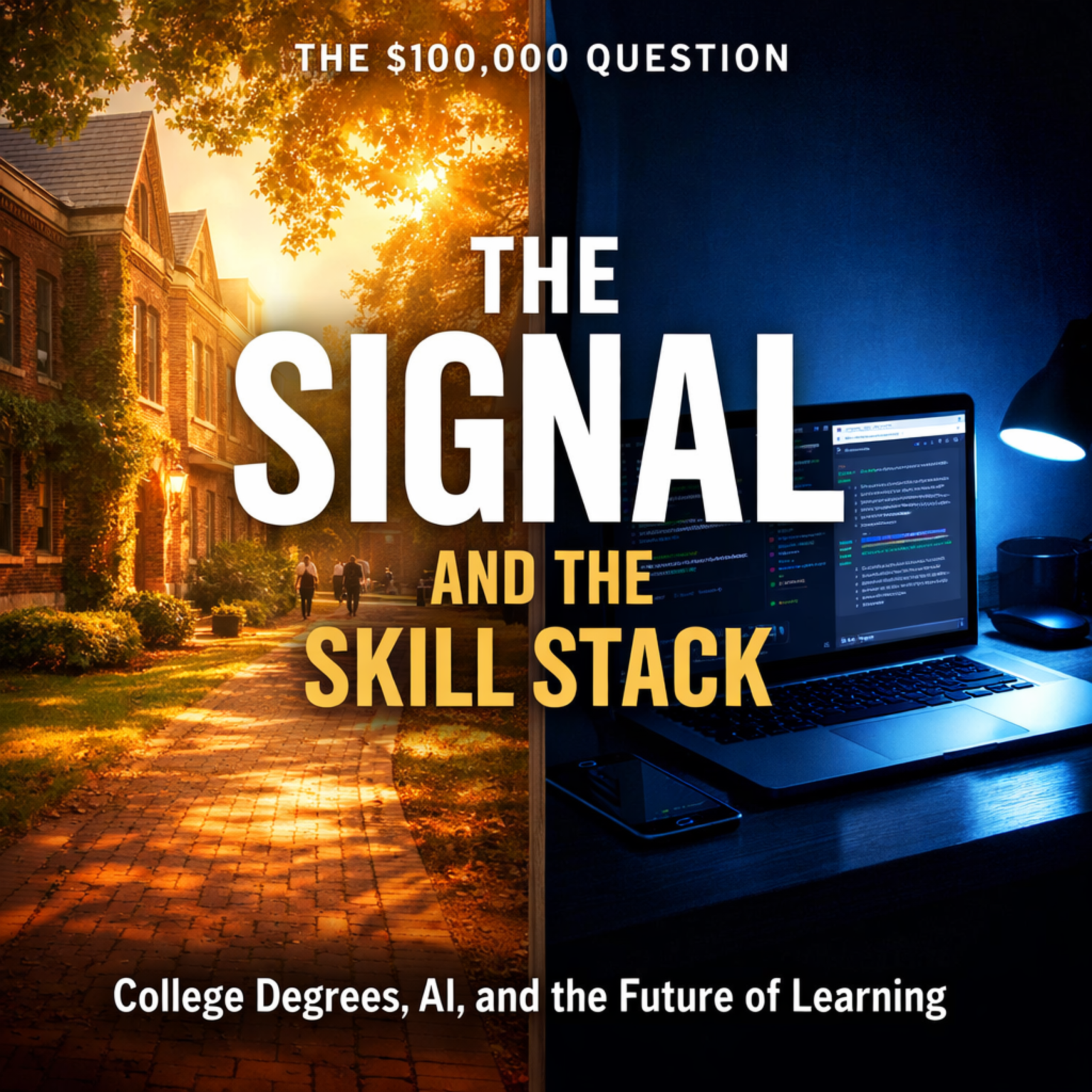
Some walk across large university campuses carrying backpacks filled with expensive textbooks. Others sit down at kitchen tables, open laptops, and begin learning from tutorials, online communities, and artificial intelligence tools.
Both groups are learning.
Both are developing skills.
Both are preparing for the same job market.
Yet the cost of these two paths can be dramatically different.
The Signal and the Skill Stack explores one of the most important questions emerging in modern education:
Are we paying for knowledge… or for the signal that proves we have it?
For most of the twentieth century, the formula was simple.
Go to college. Earn a degree. Get a job.
A university diploma acted as a powerful signal to employers. It represented discipline, commitment, and the ability to complete years of structured learning. In a world where knowledge was scarce and difficult to access, universities served as the primary gatekeepers of education.
But the world has changed.
Knowledge is no longer locked inside lecture halls.
Today, a curious learner can access tutorials, courses, mentorship, and entire communities online. Artificial intelligence can answer questions instantly, explain difficult concepts, and help learners practice new skills in real time.
Learning has become faster, more flexible, and more accessible than ever before.
And with this shift, a new idea has begun to emerge.
The skill stack.
Instead of relying on one large credential, many modern learners build their abilities piece by piece. They combine skills across disciplines — programming with design, marketing with analytics, writing with research — creating a layered structure of capabilities that grows stronger with every project.
Rather than presenting a diploma alone, they show something else.
Evidence.
Websites they built.
Applications they created.
Portfolios filled with real work.
Businesses launched from a laptop.
Employers are increasingly asking a new question.
Not just where did you study?
But also:
What have you built?
The Signal and the Skill Stack examines the growing tension between these two forms of proof. It explores why degrees once held such powerful influence, how the economics of education have changed, and why the ability to demonstrate real skills is becoming more valuable in many industries.
This audiobook is not an attack on universities.
Many professions still require structured, formal training. Doctors, engineers, pilots, and scientists depend on rigorous education systems that cannot easily be replaced.
Instead, this story invites listeners to think carefully about the price of the signal and the power of the skill stack.
As technology reshapes the way people learn and work, the future may belong to those who understand both paths — and who choose their investments in education wisely.
Somewhere tonight, two learners will sit down to study.
One in a lecture hall.
One at a laptop.
Both will enter the same world when they finish.
The only question is which signal they will carry with them.









0 Comments