Why 90% of Online Courses Never Get Finished
And What Smart Learners Are Doing Instead
Online education has exploded over the past decade.
There are now thousands of platforms offering courses on everything from digital marketing and AI to entrepreneurship, investing, and productivity. In theory, this should mean that knowledge has never been more accessible.
Yet something strange is happening.
Despite spending billions of dollars on online education each year, the vast majority of people never finish the courses they buy.
Many platforms quietly acknowledge the same uncomfortable statistic:
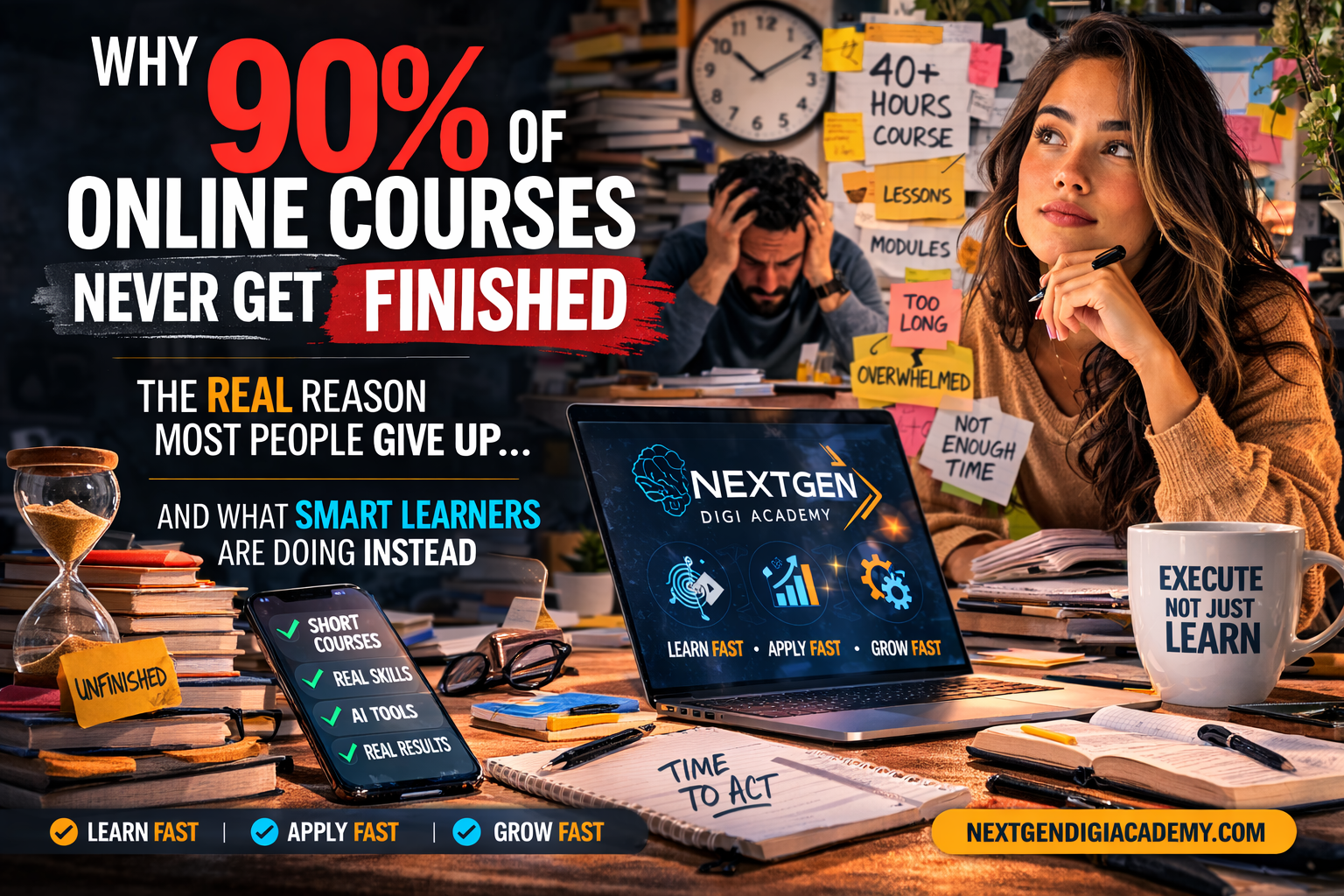
Up to 90% of online courses are never completed.
This raises an important question.
If people are motivated enough to buy the course, why do so many stop halfway through?
The answer reveals something important about how people actually learn and execute in the modern digital economy.
The Problem Isn’t Motivation — It’s the Structure
Most people assume unfinished courses are the result of laziness or lack of discipline.
But in reality, the biggest problem is structural.
Many courses are designed using a traditional academic model that emphasizes volume of content rather than speed of results.
A typical course might look like this:
- 40+ hours of video lessons
- dozens of modules
- long theoretical explanations
- extensive background lectures
While the content may be valuable, it creates a hidden psychological barrier.
When learners see a course that requires dozens of hours to complete, the brain automatically categorizes it as a long-term project rather than an actionable tool.
As a result, people start the course with enthusiasm but quickly lose momentum.
The course slowly becomes just another tab open in the browser.
Eventually it joins the digital graveyard of “things I’ll finish later.”
Information Overload Has Replaced Information Scarcity
There was a time when access to knowledge was limited.
Today, the opposite is true.
We live in a world where information is infinite.
You can learn almost anything through:
- online courses
- YouTube tutorials
- podcasts
- newsletters
- AI tools
The real bottleneck is no longer access to information.
The bottleneck is implementation.
Entrepreneurs and professionals don’t need more content.
They need faster ways to turn knowledge into action.
The Rise of the “Execution Economy”
A new learning model is emerging that prioritizes something called Time-to-Value (TTV).
Time-to-Value simply means:
How quickly can a learner apply what they just learned?
Modern professionals increasingly prefer learning experiences that allow them to gain a usable skill in minutes or hours instead of weeks.
Instead of 40-hour masterclasses, they want:
- short, focused lessons
- practical frameworks
- templates and systems
- immediate implementation
This shift represents a broader change in the digital economy.
Success today often depends on how quickly someone can turn an idea into a working system.
Learning that accelerates execution has become far more valuable than learning that simply expands theoretical knowledge.
The Psychology of Completion
Shorter learning formats dramatically increase completion rates.
When a learner sees a module that can be completed in 20–45 minutes, the brain perceives it as achievable.
This creates momentum.
Momentum leads to completion.
Completion leads to confidence.
And confidence leads to implementation.
Long courses often unintentionally create the opposite effect:
overwhelm → delay → abandonment.
In other words, the problem isn’t the learner.
The problem is the format.
Why Modern Learning Is Becoming Modular
One of the most effective responses to this problem has been the rise of modular learning systems.
Instead of delivering one massive course, knowledge is broken into smaller, focused modules that solve specific problems.
Examples include topics like:
- creating short-form video content with AI
- building an email marketing system
- launching a simple sales funnel
- generating marketing ideas using prompt frameworks
Each module focuses on one clear outcome.
Learners can implement the idea immediately and move on to the next skill when needed.
This approach mirrors how professionals actually work in the real world.
People rarely need a semester-long lecture.
They need a solution to the problem in front of them today.
The Role of AI in Accelerating Learning
Artificial intelligence has also begun transforming how learning systems are designed.
AI tools can now help learners:
- generate marketing content
- create business plans
- build automation workflows
- brainstorm ideas instantly
Instead of staring at a blank screen, learners can use structured prompts and frameworks to accelerate the execution process.
In many cases, AI becomes a form of interactive learning partner, helping translate ideas into real output.
This dramatically reduces the gap between learning and implementation.
A Different Approach to Digital Education
This shift toward faster, more practical learning is one of the ideas behind NextGen Digi Academy.
Rather than focusing on long theoretical courses, the platform emphasizes purpose-driven digital education designed around practical outcomes.
The goal is simple:
Help learners acquire useful skills and implement them quickly.
Courses are structured to focus on actionable frameworks, AI tools, and modern digital business strategies that individuals can apply in real situations.
In addition to courses, the platform also explores systems such as:
- AI prompt frameworks
- marketing strategy templates
- automation workflows
- digital entrepreneurship tools
The idea is not to overwhelm learners with endless hours of instruction.
It’s to provide practical tools that move people forward.
Learning Should Lead to Action
The real value of education has never been measured by how much information someone consumes.
It is measured by what they are able to do with that knowledge.
In the digital economy, the most successful learners are not necessarily those who study the most.
They are the ones who execute the fastest.
If a course takes weeks to finish but produces no immediate result, it becomes another forgotten resource.
But if a lesson helps someone launch an idea, automate a process, or create a new opportunity within an hour, its value becomes obvious.
The future of education will likely belong to systems that help people move from learning to doing as quickly as possible.
Because in a world full of information, execution is the real competitive advantage.
Start Your Journey
If you are interested in practical systems, modern digital skills, and AI-driven learning frameworks, you can explore more resources at NextGen Digi Academy, where new courses and tools are added regularly.
The goal isn’t to give you more content.
The goal is to help you move forward.












0 Comments